
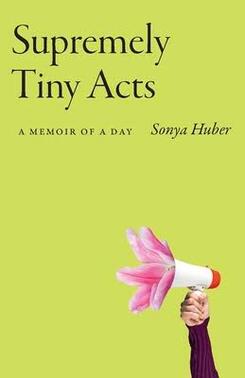
How can you write a memoir about a day? Authors generally write memoirs about entire lifetimes, not twenty-four hours. And yet, author Sonya Huber set out to record a single day in her life and all that it stood for in her newly released memoir, Supremely Tiny Acts: A Memoir of a Day.
Huber wears many hats—those of an activist, mother, wife, professor, and writer to name just a few. And in a perfect storm of sorts, Huber finds herself needing to balance all of these roles. Huber’s memoir is micro-focused on a single day. While participating in an environmental protest about climate change in Times Square, Huber is arrested. The main day chosen for the memoir, however, is Huber’s day in court following this arrest. On this same day, she finds herself grading her students’ papers (having necessarily canceled class), dealing with her rheumatoid arthritis, trying to calm her own nerves at needing to appear in court all before she is expected back to her hometown in Connecticut to take her teenage son for his driving test.
0 Comments
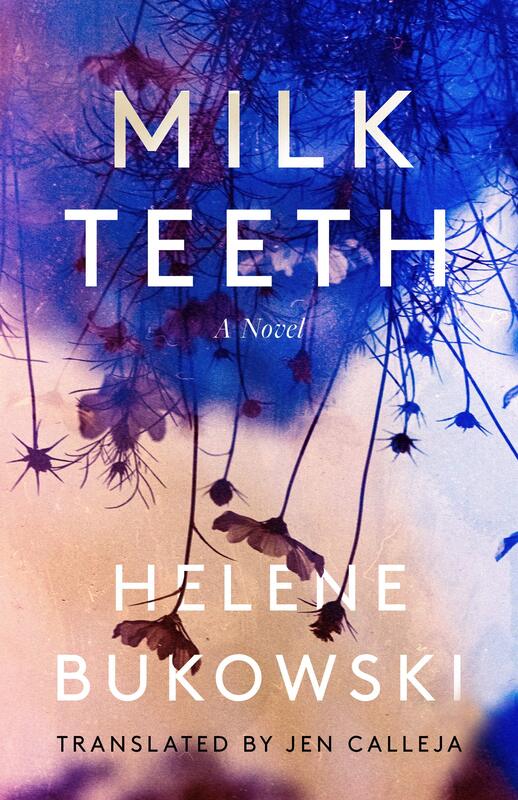
Against the backdrop of a slowly dying world, Helene Bukowski writes a beautiful and brutal story about living with trauma, the strain of motherhood, and the danger of fearing the unknown.
In the opening lines of Milk Teeth, Helene Bukowski sets the tone for the story to come: “The fog has swallowed up the sea. It stands like a wall, there, where the beach begins. I can’t get used to the sight of the water. I’m always looking for a bank on the opposite side that could reassure me, but there’s nothing but sea and sky. These days, even this line is blurred.” Beautiful, brutal, and eerily accessible, the story of Milk Teeth is one that peels back the layers we build around fear; it lays them bare along tainted waters and dares its readers to move through the fear and into the beyond.
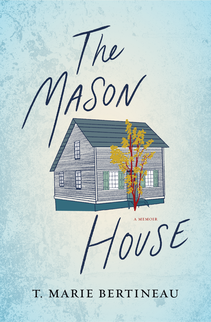
Not understanding what you have until you lose it is a bitter feeling. But losing something you’ve always recognized as important leaves a unique wound. The Mason House is a wonderfully vivid memoir painting the likeness of a young woman and her family dealing with that wound and doing their very best from allowing it to fester. And similarly to the many others who have and still must do the same, Marie and her family members struggle to adapt.
Loss is the key emotion of The Mason House and the author, T. Marie Bertineau, makes us clearly understand her loss of her “Gramma,” the owner of The Mason House, by showing us who Gramma was through her own eyes. Bertineau is great at presenting instantly recognizable people. And the picture she paints of Gramma is one of a genuine, if not often harsh, person with woods lady wisdom. A cool, sometimes enigmatic woman who is worth inheriting some personality from.
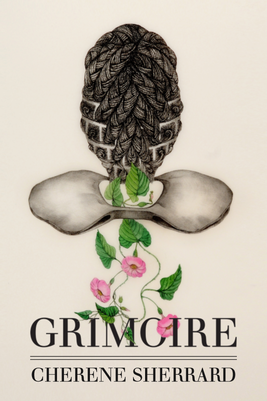
On her dedication page, Cherene Sherrard indicates her poetry collection, Grimoire, is “[f]or the mothers.” I am left with the following question: what makes a mother a “mother?” Is it the nine months of carrying a child in the womb, giving birth, and then raising said child? Or is it simply the act of loving a child, despite not ever meeting them due to gestation or birth complications?
I ask this question because many of the speakers in Grimoire are childless, either due to miscarriages, complications, or stillbirths. Are they included in Sherrard’s dedication to “mothers”? Can they even be considered mothers without living children? These mothers in Grimoire, who have lost their babies, are Black mothers in America, and for many, they have lost their babies due to factors out of their control such as miscarriages and institutionalized racism.
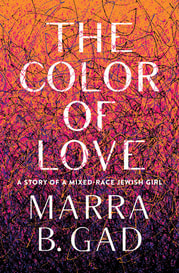
“There are two things that happen when someone is trying to decide [...] where they are going to put your otherness,” Marra B. Gad writes in her new book The Color of Love. “For some, there is a blankness in the eyes that takes over, as if they are lost in thought,” but for others, “there is an immediate narrowing, a sharpness that engages. And it is because they don’t need to think.” For Marra, these two reactions encompassed much of her world. In the prologue, Marra describes her background as a mixed Jewish woman, half white and half black, who was adopted by a Jewish family in 1970. To Marra, the labels she identifies with don’t matter, shouldn’t matter, yet, “For many, identity is literally a black-and-white matter.” Something that is, or isn’t.
|
Archives
April 2024
Categories
All
|
 RSS Feed

|
Glassworks is a publication of Rowan University's Master of Arts in Writing 260 Victoria Street • Glassboro, New Jersey 08028 glassworksmagazine@rowan.edu |
All Content on this Site (c) 2024 Glassworks
|