
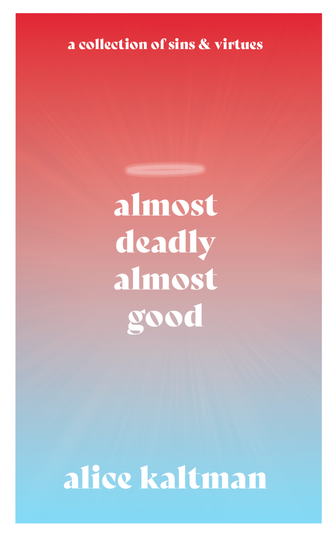
Most of us are familiar with the concept of the seven deadly sins: gluttony, envy, wrath, lust, sloth, to name a few. Alice Kaltman embraces these sins—along with their virtuous counterparts—in her short story collection, Almost Deadly, Almost Good. She personifies the sins in her complex characters while exploring an equal number of virtues. Her stories depict the tragedies and triumphs of human nature. Characters embodying gluttony, envy, and wrath seem to be in a constant state of inner conflict and turmoil while those who practice kindness, humility, and patience have better outcomes. Kaltman has cleverly woven some of her characters into multiple stories where they interact with other characters in surprising and unpredictable ways, paying homage to "the six degrees of separation,” that wonderful theory that proposes people are inextricably connected through a chain of acquaintances. This technique of writing brings richness and clarity to her characters by allowing us to read about them from the perspective of others. Kaltman’s intersecting stories are shocking in their outcomes—sometimes ending in tragedy. She writes with such intensity and clarity of the flawed human condition that it’s difficult not to feel the raw emotions that her characters experience, such as Miriam’s betrayal in "Lust" where she develops a crush on her daughter’s middle-aged boyfriend and attempts to steal a kiss from him. He recoils in horror as his future mother-in-law crosses an unspoken boundary. In "Sloth" we meet Cecil Jones, a lonely, overweight man in his 50s, bereft of purpose, ambition, and friends. He quits his boring office job to travel the world living a self-indulgent life only to experience an existential crisis. While on a layover during his return home, a chance sighting of baby seals stirs something within him, luring him over the edge of a dangerous cliff to spend his final moments with them. His older sister Bonnie sheds light on his upbringing in "Wrath" where she recounts how her father used to beat her while Cecil cried and hugged her. When their mother left her abusive husband, Bonnie took on the maternal role and all that came with it, including taking care of Cecil. If we find ourselves judging Kaltman’s characters too harshly, then perhaps that exposes the vice of self-righteousness in us, which is also a sin. Perhaps we identify with one or more of her characters; maybe we made the same choices they did and experienced the same consequences. We are all beautiful and flawed in some way. The lesson is judge not lest ye be judged! Perhaps we identify with one or more of her characters; maybe we made the same choices they did and experienced the same consequences. The seven stories of virtue show us equally fascinating characters. In "Kindness" we see grief-stricken Beth jump off a cruise ship, believing she has seen her dead son on Monkey Island. A fellow passenger jumps off to go rescue her and the two women share a mutual understanding of the pain they have suffered. In "Humility" a pair of swan-shaped earrings captivates Doris, who has always lived a modest, humble life. She only wears the beautiful swan earrings when no one else can see and finds simple joy in how they make her feel inside. Even these touching stories of virtue show the complexities of these noble characters’ lives.
It’s not until we’ve read all of Kaltman’s 14 short stories together that we gain greater understanding of her characters, their complex emotions, and the struggles they face in seemingly hopeless situations. The fleeting pleasures they experience due to their poor choices come with lasting (and often tragic) consequences. In some of these stories we see the tragic result of childhood trauma that was never healed. Loneliness, isolation, and unmet needs are often met in all the wrong places as adults. Kaltman’s characters—the flawed and the flawless—embody the best and worst of human nature as some practice kindness, humility, and charity while others grapple with lust, envy, and pride. Reality sometimes has a way of bringing people to their senses before all is lost and Kaltman emphasizes this in many of her colorful and complex characters. None of her characters are completely bad or completely good, but seem to embody a grey morality which discourages judgement and leads us to a vexing question: is it possible to be both good and bad at the same time? To err is human. To love is human. The answer is almost.
0 Comments
Leave a Reply. |
Archives
July 2024
Categories
All
|
 RSS Feed

|
Glassworks is a publication of Rowan University's Master of Arts in Writing 260 Victoria Street • Glassboro, New Jersey 08028 [email protected] |
All Content on this Site (c) 2024 Glassworks
|